
Executive Summary & Legal Position
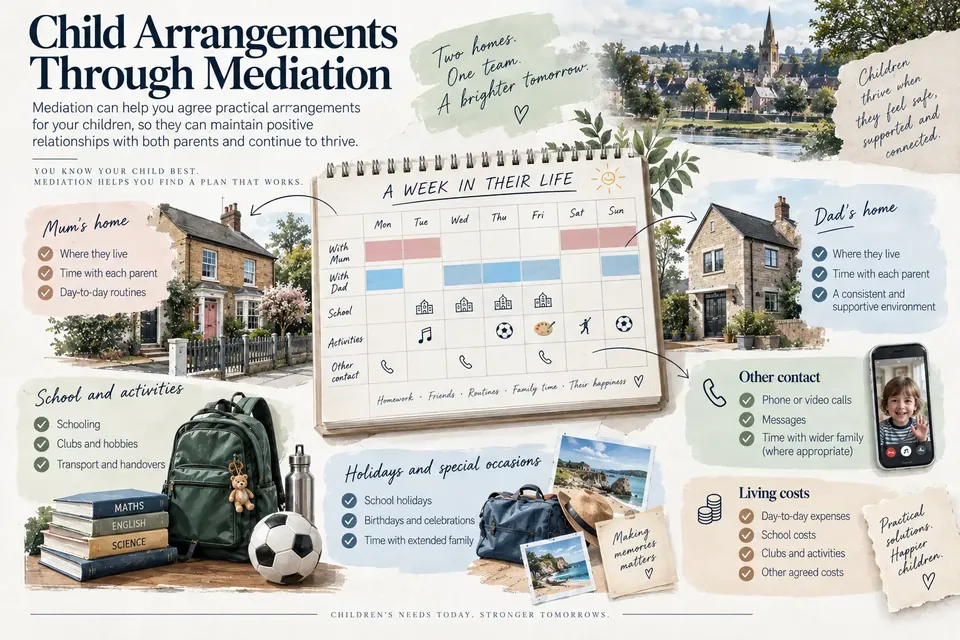
While English law under Section 1(2A) of the Children Act 1989 establishes a presumption of parental involvement, there is no automatic statutory right to a mathematical 50/50 split. Courts and mediators assess shared care based on practical feasibility: parental proximity, parents’ communication quality, work flexibility, and the child’s age. The two most successful 50/50 rota patterns are: (1) the 2-2-5-5 rotation (2 days with parent A, 2 days with parent B, alternating 5-day weekends), which provides weekday consistency; and (2) the 7-7 alternating weekly rotation (switch every Friday after school), best suited for secondary school children.
Core Dispute Question: How can separated parents negotiate a sustainable, child-focused 50/50 shared care rota without courtroom conflict?
Applicable UK Family Law & Judicial Rules
Children Act 1989 Section 1 (welfare checklist) and Children and Families Act 2014 Section 11 (presumption of parental involvement).
Judges possess statutory authority to pause court timetables and order cost sanctions against parties unreasonably refusing mediation.
Under Section 10 of the Children and Families Act 2014, self-certification is strictly scrutinized. Authorised FMC mediator signatures are mandatory on Form C100 / Form A.

Step-by-Step Resolution Roadmap for Parents & Spouses
Select a Rota Model Suited to Your Child’s Developmental Stage
Choose shorter 2-2-3 or 2-2-5-5 rotations for toddlers and primary school children to minimize days away from either parent, reserving 7-7 week-about rotas for older children.
Utilize School as the Neutral Changeover Hub
Conduct handovers directly at school drop-off and collection (Parent A drops off Monday morning, Parent B collects Monday afternoon) to eliminate stressful front-door interactions.
Standardize Duplicated School Essentials and Clothing
Equip both households with complete sets of school uniforms, sports kits, and toiletries so children do not feel like perpetual luggage carriers between homes.
Harmonize Core Rules on Homework, Bedtimes, and Screen Time
Agree foundational household expectations in your mediated Parenting Plan to prevent children from playing parents off against one another.
Adopt a Shared Digital Co-Parenting App
Use a co-parenting platform (e.g. OurFamilyWizard or 2Houses) for all calendar updates, medical appointments, and expense logs to maintain transparent communication.
Facing an Urgent Standoff on This Issue?
Fast-track confidential MIAM sessions available within 24–48 hours. Accredited court form sign-off provided.
Common Tactical Mistakes to Avoid
Booking flights without written consent, cancelling joint mortgages unilaterally, or withholding passports triggers emergency court applications that judges view with severe disfavor.
Filing Form C100 or Form A without an accredited mediator signature risks automatic strike-out or adverse cost sanctions under amended Family Procedure Rules Part 28.3.
A 50/50 rota requires high parental cooperation and geographic proximity (living within 15–20 minutes of school). If parents live far apart, have high ongoing hostility, or work unpredictable shift hours, mediation will explore customized shared care (e.g. 60/40 or alternate weekends plus mid-week dinners) rather than unworkable rigid equality.
Designated Family Court Centres in Your Catchment Area
If mediation does not reach complete settlement, your accredited FMC mediator issues the official signed certificate required for submission to these regional family court centres:
90 Wellington Street • LE1 6HG
If mediation concludes without agreement, an authorized FMC mediator will sign your C100 or Form A for submission to Leicester Combined Court Centre.
90 Wellington Street, Leicester • LE1 6HG
Charnwood family cases are allocated to Leicester Combined Court Centre; our mediation service supplies the certified court documentation needed for application.
Carrington Street, Nottingham • NG2 1EE
The Nottingham Justice Centre strictly enforces the requirement for a mediator-signed MIAM certificate on all Children Act 1989 Section 8 applications.
Explore Accredited Child Arrangements Mediation in Your Practice Hub:
Our accredited mediators deliver fast-track video appointments and in-person sessions across regional family court districts:
Related Family Law Articles & Practical Advice
Who Keeps the Children's Passports After Separation? UK Family Law & Mediation Guide
Dividing the Six-Week Summer Holiday: Practical Solutions for Separated Parents
When Separated Parents Disagree on Taking a Child Abroad: Mediation & Court Rules
Book Your Confidential MIAM Consultation
Take the first constructive step toward resolution. Individual pre-court assessment meetings conducted remotely or at regional centres.